Launch offer — valid today only

📄 Digital book in PDF · read it on your phone or print it

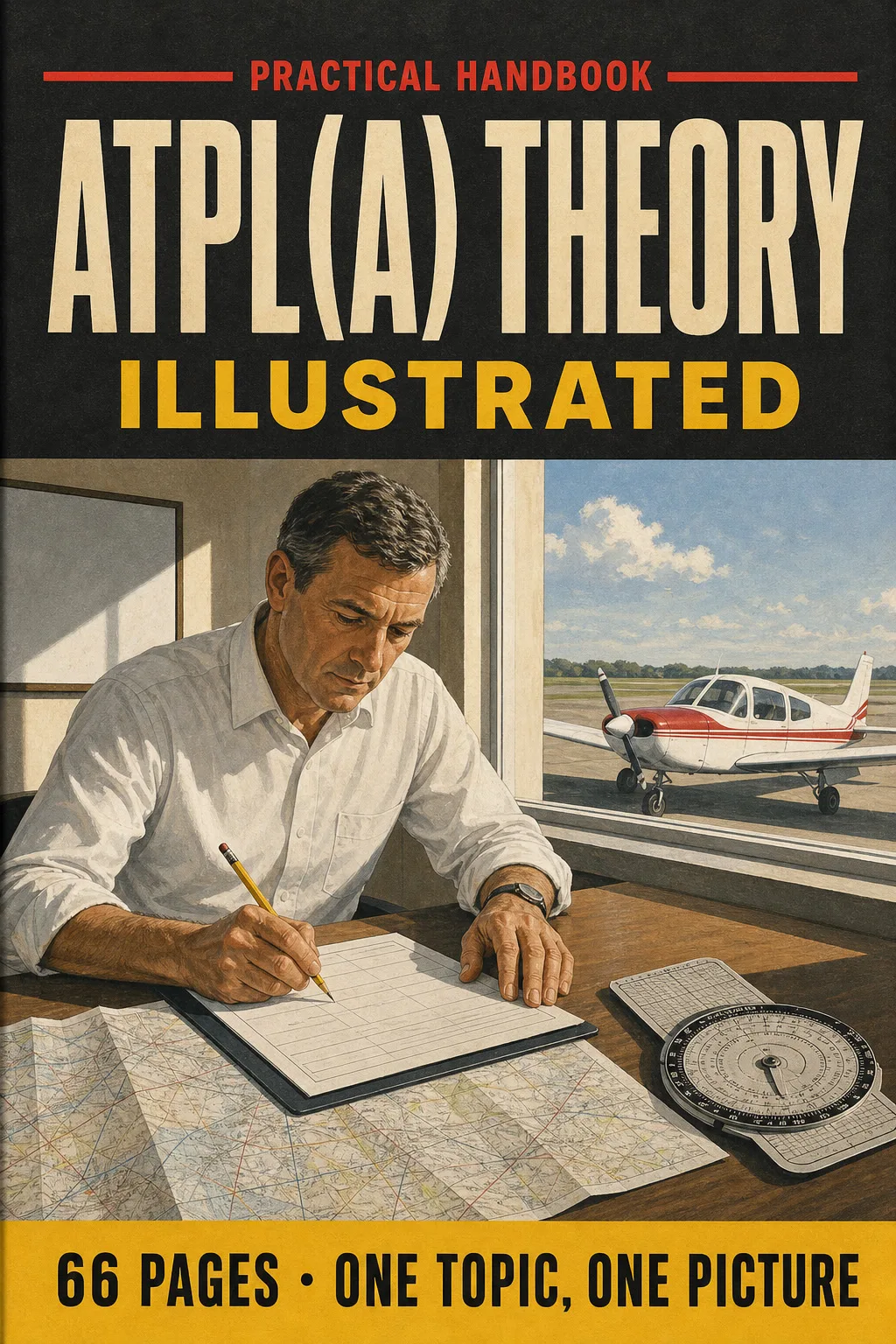
UK ATPL(A) Theory in Drawings: Every Subject Pictured, Ready to Revise Before Each Sitting One Topic on Every Page

The lift curve, the turbofan, pitot-static blockages, fronts, great circles, VOR and ILS, the mass ladder, fuel planning and UK airspace. Each topic has its own page: the drawing first, then what you need to remember. 66 illustrated pages.

START STUDYING THIS WAY

🔒 Secure checkout · PDF by email · 30-day guarantee

Every topic, its own pageEach concept drawn, with the explanation beside it
66 illustrated pages9 parts, from the lift equation to planning your exam sittings
Up-to-date sourcesUK CAA ATPL(A) syllabus learning objectives and UK Part-FCL
PDF by emailFormat

Look Inside the Book

Every page has one large drawing and a box with the numbers, formulas and steps you need to know:

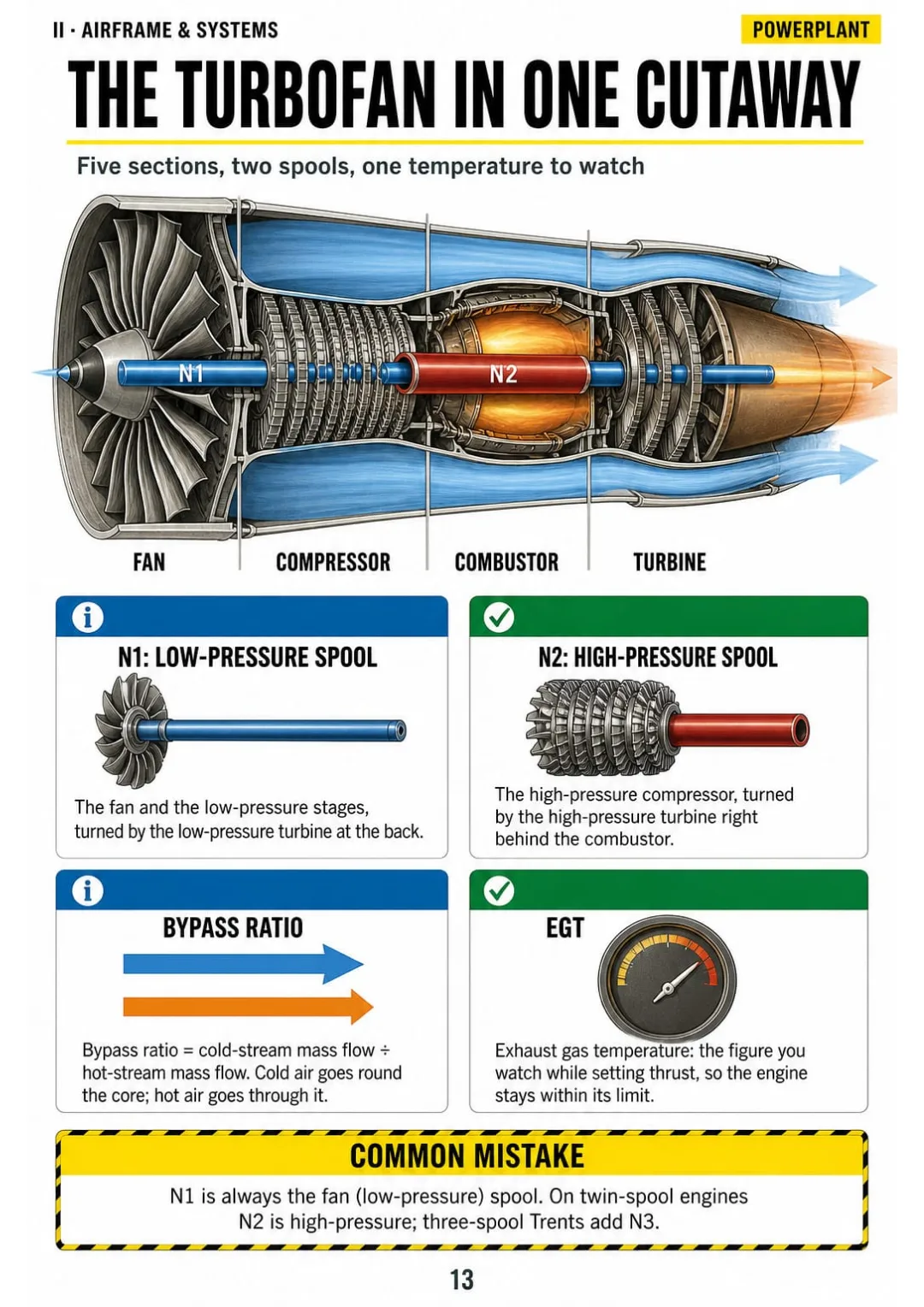
N1 = low-pressure spool, N2 = high-pressure spool, bypass ratio = cold ÷ hot air.
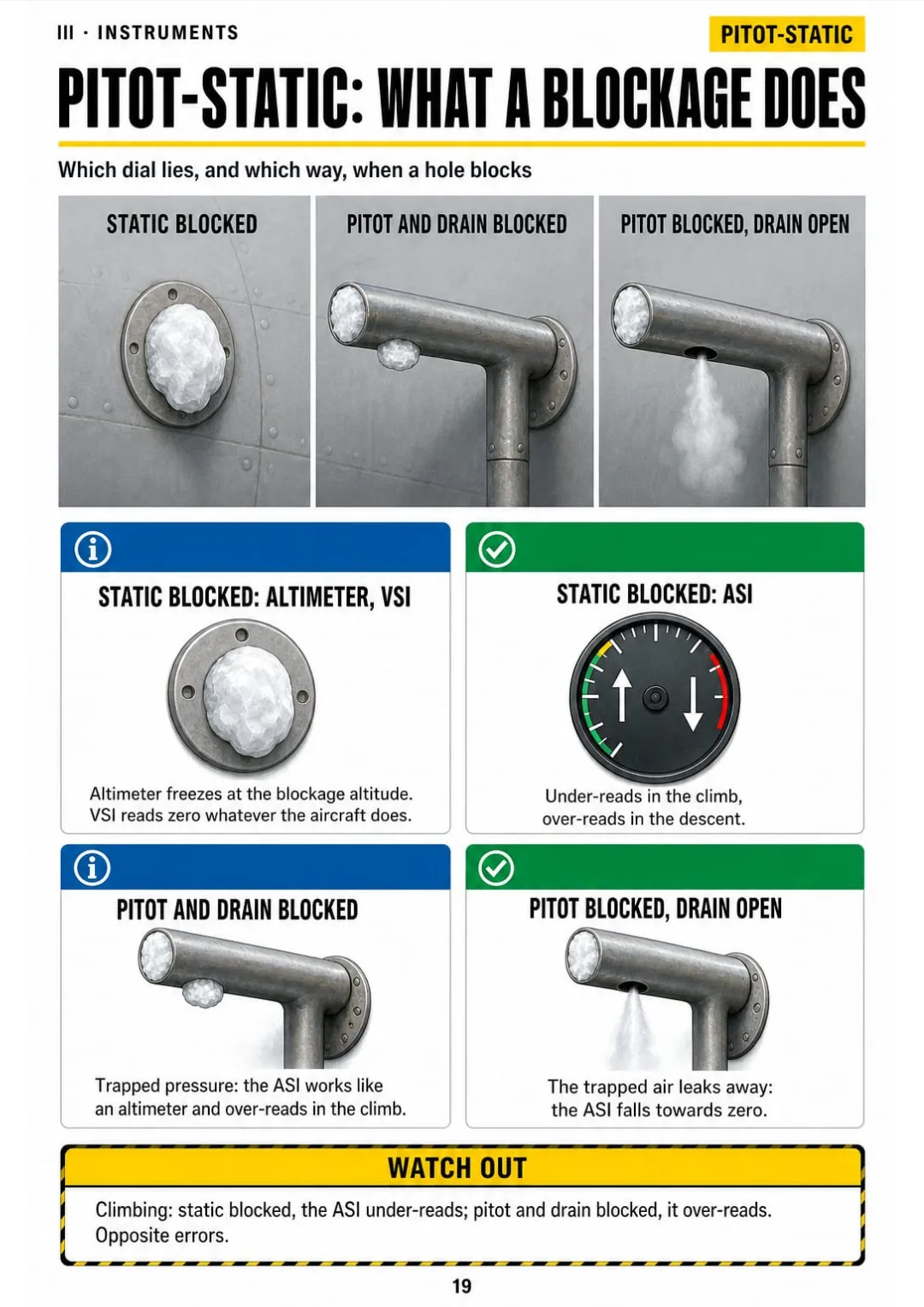
Static blocked: altimeter freezes, VSI zero, ASI under-reads climbing. Pitot + drain blocked: ASI over-reads climbing.
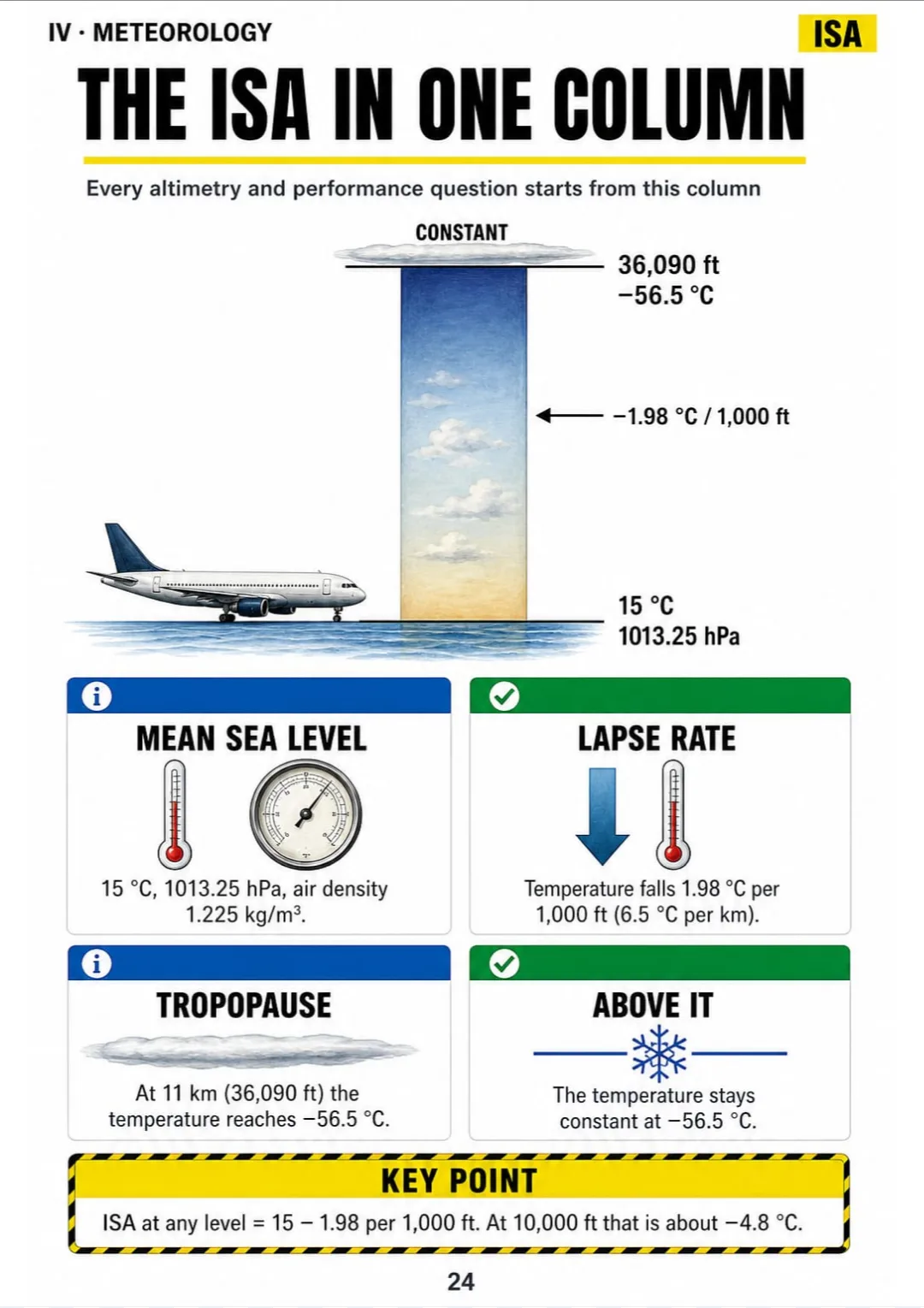
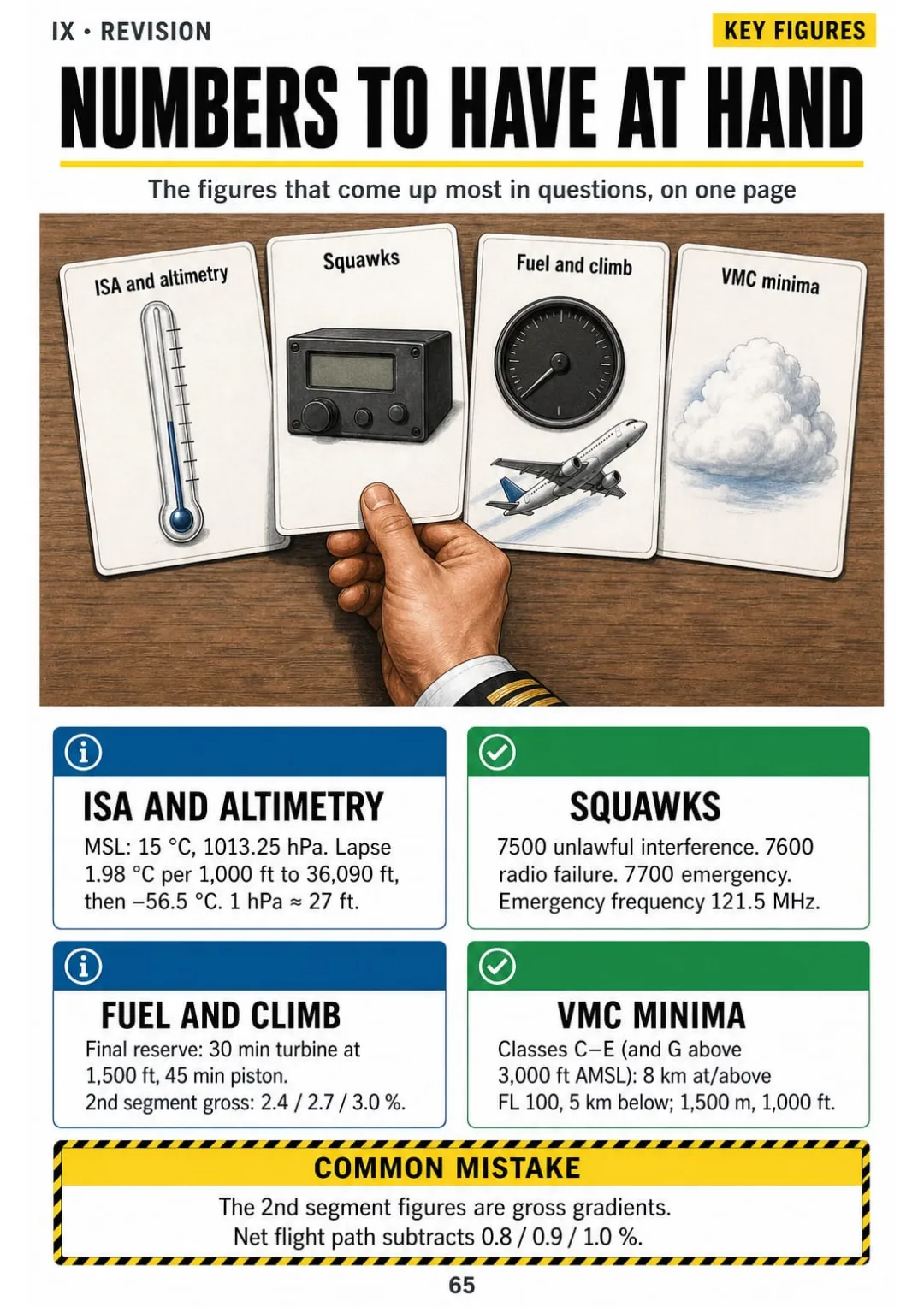
ISA: 15 °C and 1013.25 hPa at sea level, −1.98 °C per 1,000 ft to −56.5 °C at 36,090 ft.
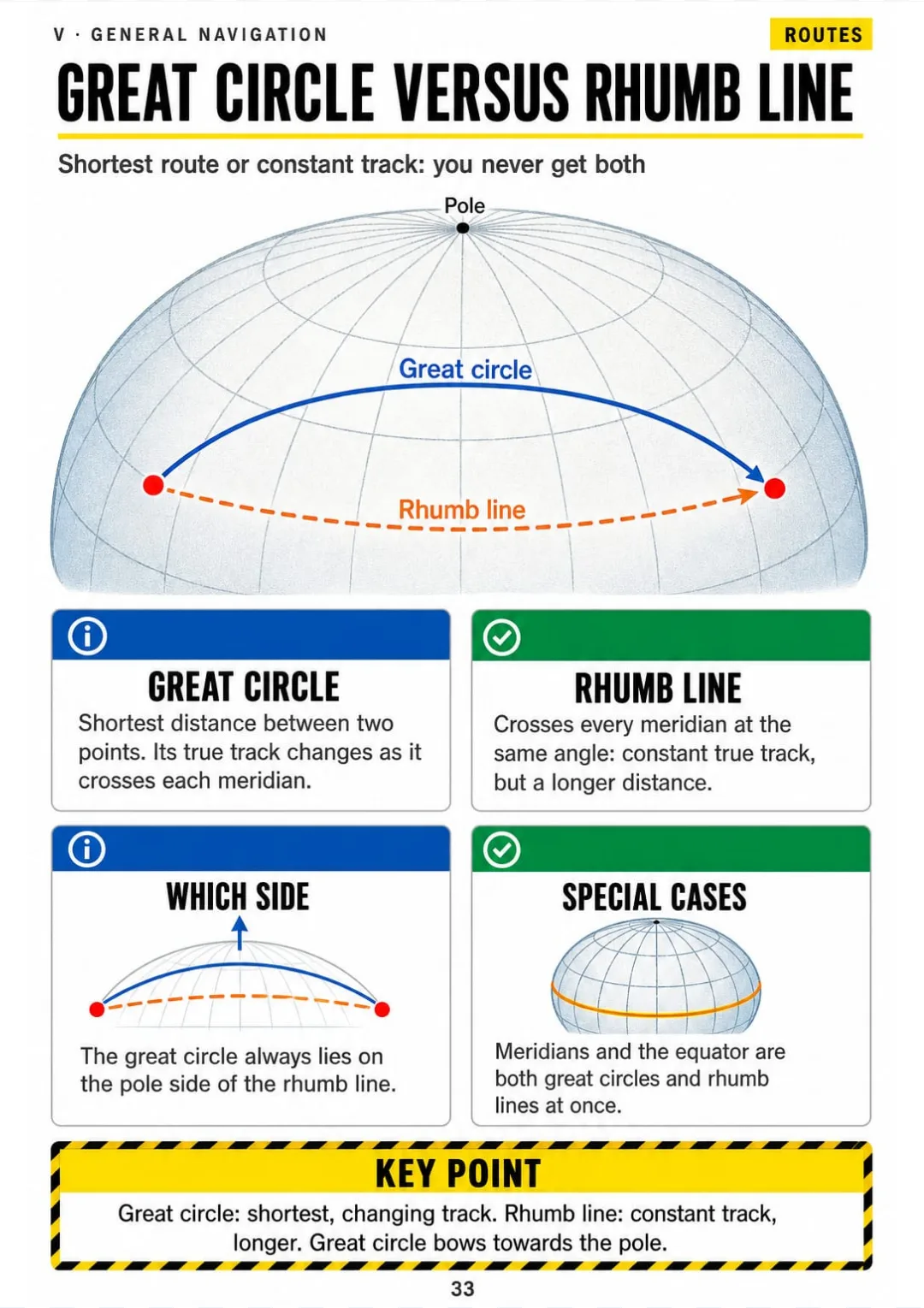
The great circle is shorter, the rhumb line keeps one track; the great circle sits poleward.
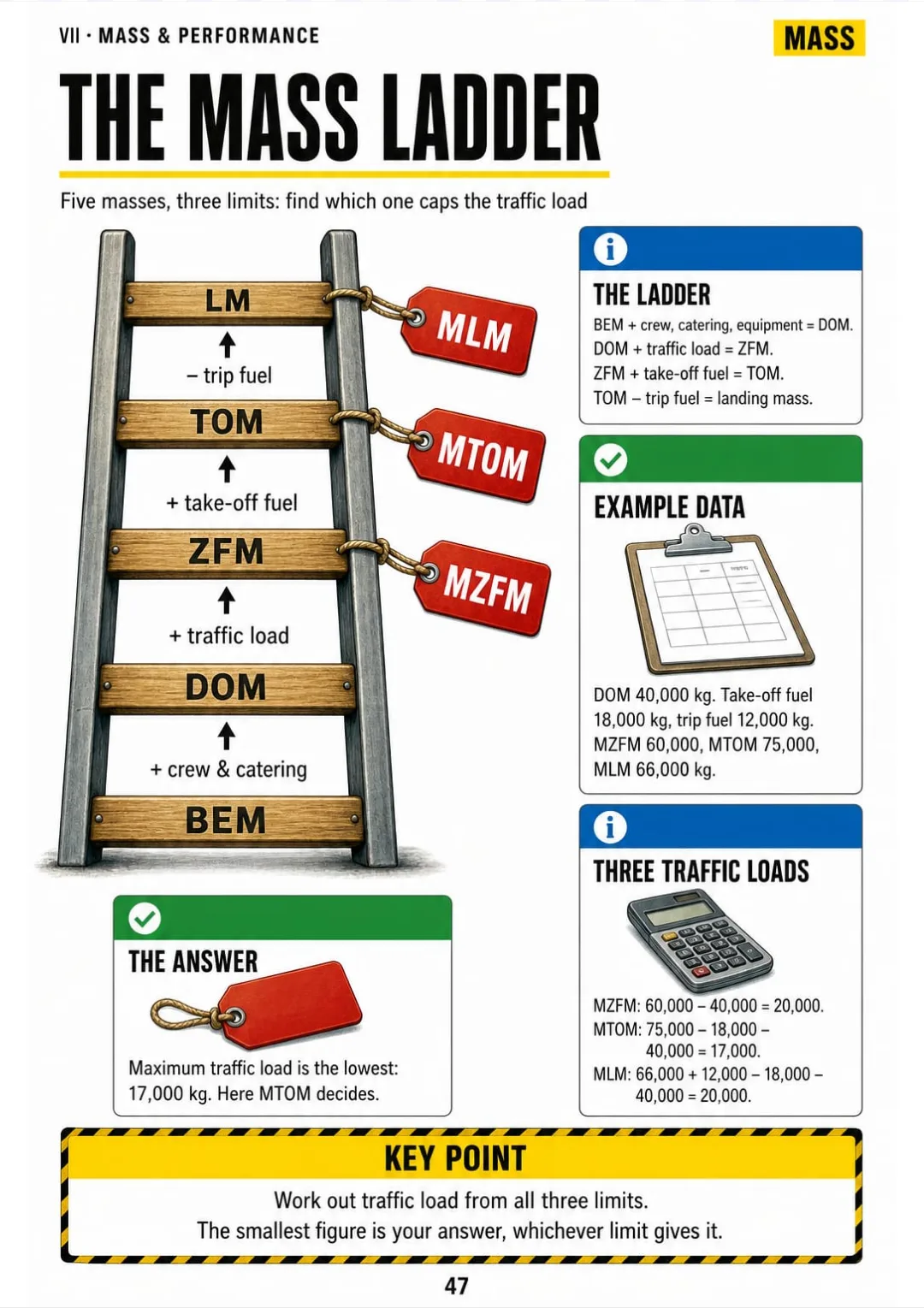
BEM → DOM → ZFM → TOM → landing mass, with MZFM, MTOM and MLM checked on every step.
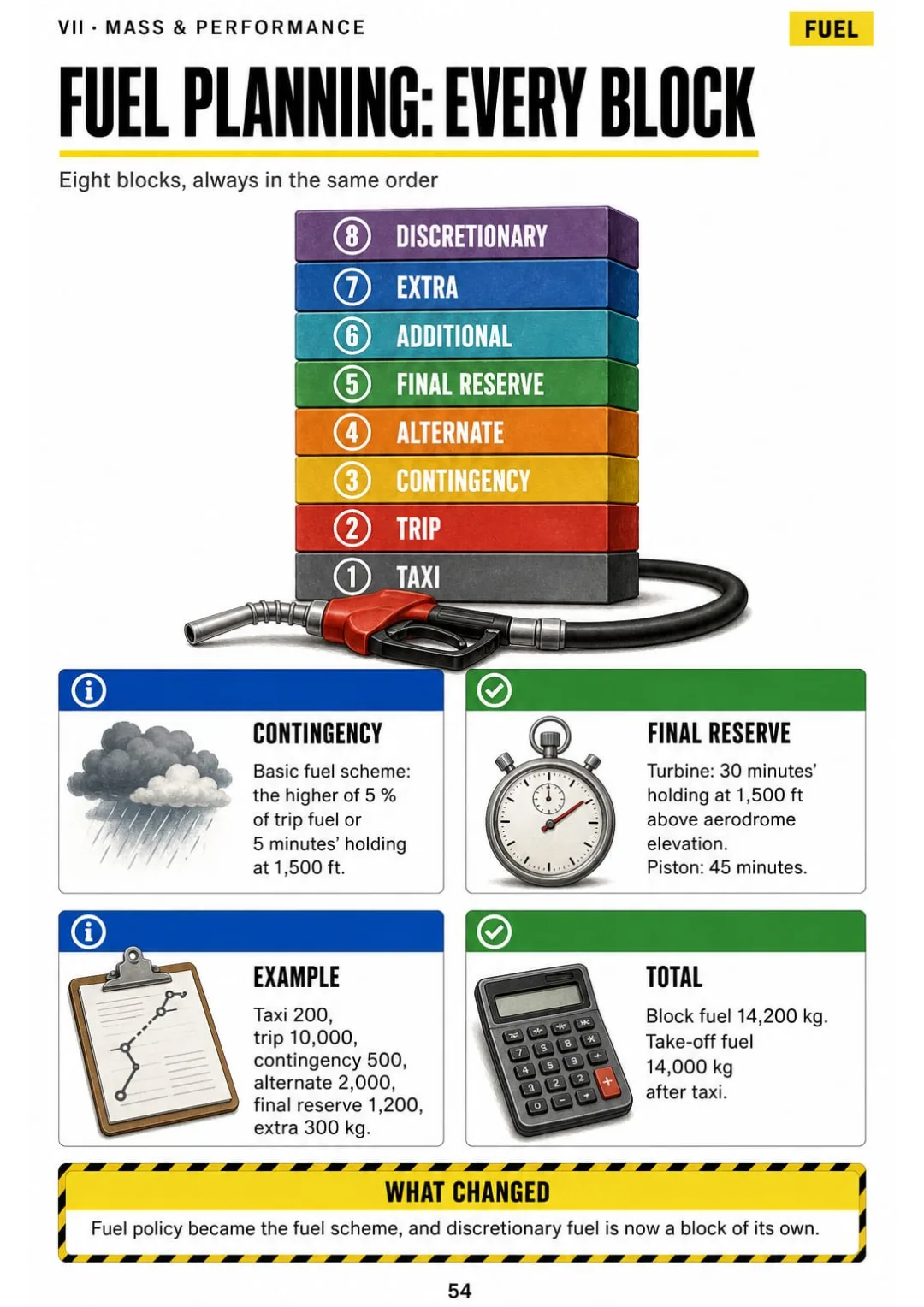
Taxi, trip, contingency (5 %), alternate, final reserve (30 min jet), additional, extra, discretionary.
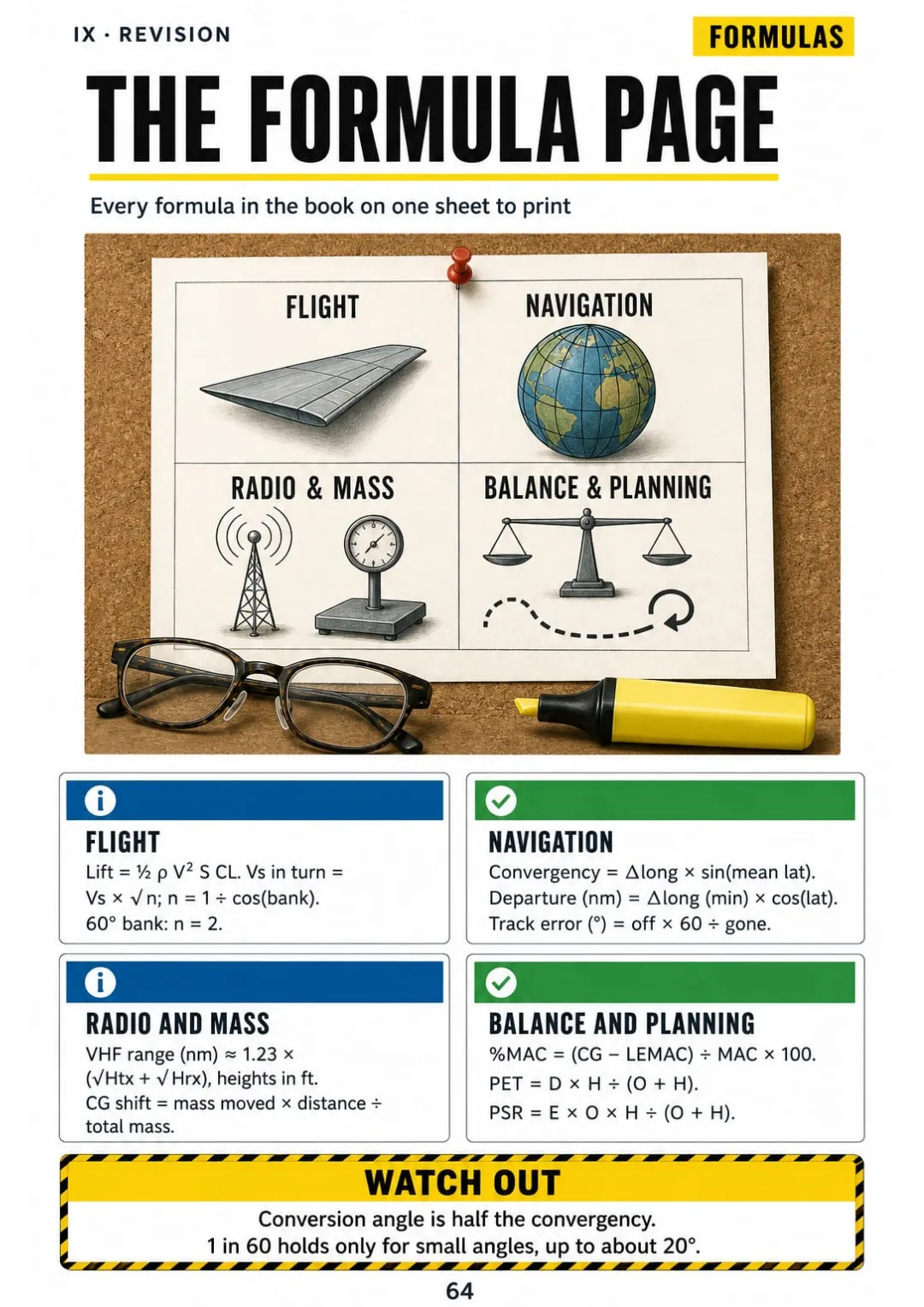
Lift, load factor, convergency, departure, 1 in 60, VHF range, CG shift, %MAC, PET and PSR on one page
15 °C, 1013.25 hPa, 27 ft per hPa, 7500/7600/7700, 30/45 min reserve and VMC minima

Swipe to see more →

These are real pages from the book. The table of contents is the full one: 9 parts and 62 topics.

The Problem Isn't You. It's How It Was Explained to You.

It's half past ten, the Met paper is booked, and you're looking at a question on the cloud sequence ahead of a warm front.

The manual gives you two pages of prose: warm air overrunning, a shallow slope, layered cloud, a veering wind. Words alone don't build a picture you can keep.

ISA: 15 °C and 1013.25 hPa at sea level, −1.98 °C per 1,000 ft to −56.5 °C at 36,090 ft.

In the book, it's one cross-section. The warm front slopes gently with Ci, Cs, As and Ns stacked along it and steady rain underneath. Next to it, the cold front: steeper, Cb, showers and a sharp veer.

The same goes for great circles, VOR radials, a blocked static port, the mass ladder and the fuel blocks: each one has its own page.

So when the question asks which cloud comes first, you see the drawing and answer without going back to the manual.

COMPARE FOR YOURSELF

The Same Topic, Two Ways to Study It

THIS
  • The manual: line after line
  • Pitot-static blockages explained only in words
  • You reach the exam still unsure
Should the static source become obstructed during flight, the pressure trapped within the static lines will remain at the value corresponding to the altitude at which the obstruction occurred. Consequently, the altimeter will continue to indicate that altitude irrespective of subsequent changes in level, while the vertical speed indicator, being unable to sense any rate of change of static pressure, will return to zero. The airspeed indicator will under-read in a climb and over-read in a descent, since the static pressure applied to the capsule respectively exceeds or falls short of ambient.
FOR THIS
  • The pitot-static system in one drawing
  • What each instrument does, in a box
  • You see it and it makes sense
Static blocked: altimeter freezes, VSI zero, ASI under-reads climbing. Pitot + drain blocked: ASI over-reads climbing.
CONTENTS

Take a Look at the 9 Parts and 62 Topics

All 13 UK CAA ATPL(A) exam subjects: Air Law (UK rules and airspace), Aircraft General Knowledge, Instrumentation, Mass and Balance, Performance, Flight Planning, Human Performance, Meteorology, General Navigation, Radio Navigation, Operational Procedures, Principles of Flight and Communications, plus a revision section. 66 pages, all illustrated.

IPrinciples of Flight · pp. 5-12
  1. The lift equation in one drawing
  2. The lift curve and the critical angle
  3. The drag curve and VMD
  4. Load factor and stall speed
  5. Flaps raise CLmax, slats raise the critical angle
  6. High-speed flight: Mcrit and the shock wave
  7. Static and dynamic stability
  8. Why airliner wings are swept
IIAirframe, Systems and Powerplant · pp. 13-18
  1. The turbofan in one cutaway
  2. Thrust versus temperature and altitude
  3. Hydraulics: pressure = force ÷ area
  4. Pressurisation and cabin altitude
  5. Aircraft electrics: AC and DC
  6. Anti-ice versus de-ice
IIIInstruments · pp. 19-23
  1. Pitot-static: what a blockage does
  2. IAS, CAS, EAS, TAS and Mach
  3. QNH, QFE and the standard setting
  4. Gyros: rigidity, precession and drift
  5. Magnetic compass errors
IVMeteorology · pp. 24-31
  1. The ISA in one column
  2. Cold air: the altimeter lies high
  3. Stability: DALR, SALR and ELR
  4. Wind: geostrophic flow and surface friction
  5. Warm and cold fronts in cross-section
  6. Thunderstorms and microbursts
  7. Airframe icing types
  8. Reading a METAR and a TAF
VGeneral Navigation · pp. 32-39
  1. True, magnetic and compass
  2. Great circle versus rhumb line
  3. Convergency and conversion angle
  4. Departure: east–west distance
  5. Time: arc to time and UTC
  6. Chart projections and scale
  7. The triangle of velocities
  8. The 1 in 60 rule
VIRadio Navigation · pp. 40-46
  1. Radio waves and VHF range
  2. NDB and ADF: relative bearings
  3. VOR: radials go FROM
  4. DME: slant range
  5. ILS: localiser and glideslope
  6. Primary and secondary radar
  7. GNSS, RAIM and PBN
VIIMass & Balance, Performance and Flight Planning · pp. 47-55
  1. The mass ladder
  2. Moments and the CG
  3. Shifting mass: the CG shift formula
  4. CG as a percentage of MAC
  5. TORA, TODA, ASDA and V-speeds
  6. High, hot, heavy, wet: what changes
  7. Class A climb segments
  8. Fuel planning: every block in order
  9. PET and PSR
VIIIAir Law, Operations, Communications and Human Performance · pp. 56-62
  1. UK airspace classes
  2. VMC minima
  3. Rules of the air and navigation lights
  4. Distress, urgency and the Q codes
  5. De-icing fluids and holdover time
  6. Hypoxia and time of useful consciousness
  7. Vestibular illusions
IXRevision and Exam Practice · pp. 63-66
  1. Draw it before you pick a letter
  2. The formula page
  3. Numbers to have at hand
  4. Planning your exam sittings

One Page, One Topic, All Clear

Think of it this way:

You're in the exam. The question gives you a change of longitude and a mean latitude and asks for the conversion angle. The clock is running.

In your head you see the convergency page you revised: two meridians closing towards the pole, the great circle curving between them, and convergency = ch. long × sin mean lat, conversion angle = half of it, in one box.

BEM → DOM → ZFM → TOM → landing mass, with MZFM, MTOM and MLM checked on every step.

The same with the lift curve, the ISA column, VOR radials, the CG shift formula and VMC minima: each one on its own page.

ATPL(A) Theory Illustrated is 9 parts and 62 topics, all drawn, and at the end a formula page, the numbers to have at hand and a plan for your exam sittings.

What you see drawn, you don't have to memorize.

What's Inside ATPL(A) Theory Illustrated:

Ipp. 5-12

Principles of Flight

Why it flies and why it stalls, one page each: the lift equation, the lift and drag curves, VMD, load factor and stall speed, flaps and slats, Mcrit, stability and swept wings.

IIpp. 13-18

Airframe, Systems and Powerplant

The turbofan in one cutaway, thrust with temperature and altitude, hydraulics, pressurisation, AC and DC electrics, anti-ice and de-ice.

IIIpp. 19-23

Instruments

Pitot-static blockages, IAS to Mach, QNH, QFE and standard, gyro rigidity and precession, and compass errors.

IVpp. 24-31

Meteorology

The ISA, cold-air altimeter error, DALR, SALR and ELR, geostrophic wind, fronts in section, thunderstorms, icing, METARs and TAFs.

Vpp. 32-39

General Navigation

The calculations you can picture before you work them out: true, magnetic and compass, great circle and rhumb line, convergency, departure, time and UTC, projections, the triangle of velocities and the 1 in 60 rule.

VIpp. 40-46

Radio Navigation

VHF range, NDB and ADF, VOR radials, DME slant range, ILS, primary and secondary radar, GNSS, RAIM and PBN.

VIIpp. 47-55

Mass & Balance, Performance and Flight Planning

The mass ladder, moments and CG, the CG shift formula, %MAC, declared distances and V-speeds, high-hot-heavy-wet, climb segments, fuel blocks, PET and PSR.

VIIIpp. 56-62

Air Law, Operations, Communications and Human Performance

UK airspace classes, VMC minima, rules of the air and lights, distress and urgency, de-icing fluids, hypoxia and vestibular illusions.

IXpp. 63-66

Revision and Exam Practice

Drawing it before you pick a letter, the formula page, the numbers to have at hand and planning your exam sittings.

At the end of the book: A formula page, the numbers to have at hand and a plan for your exam sittings.

Plus: 2 Free Books

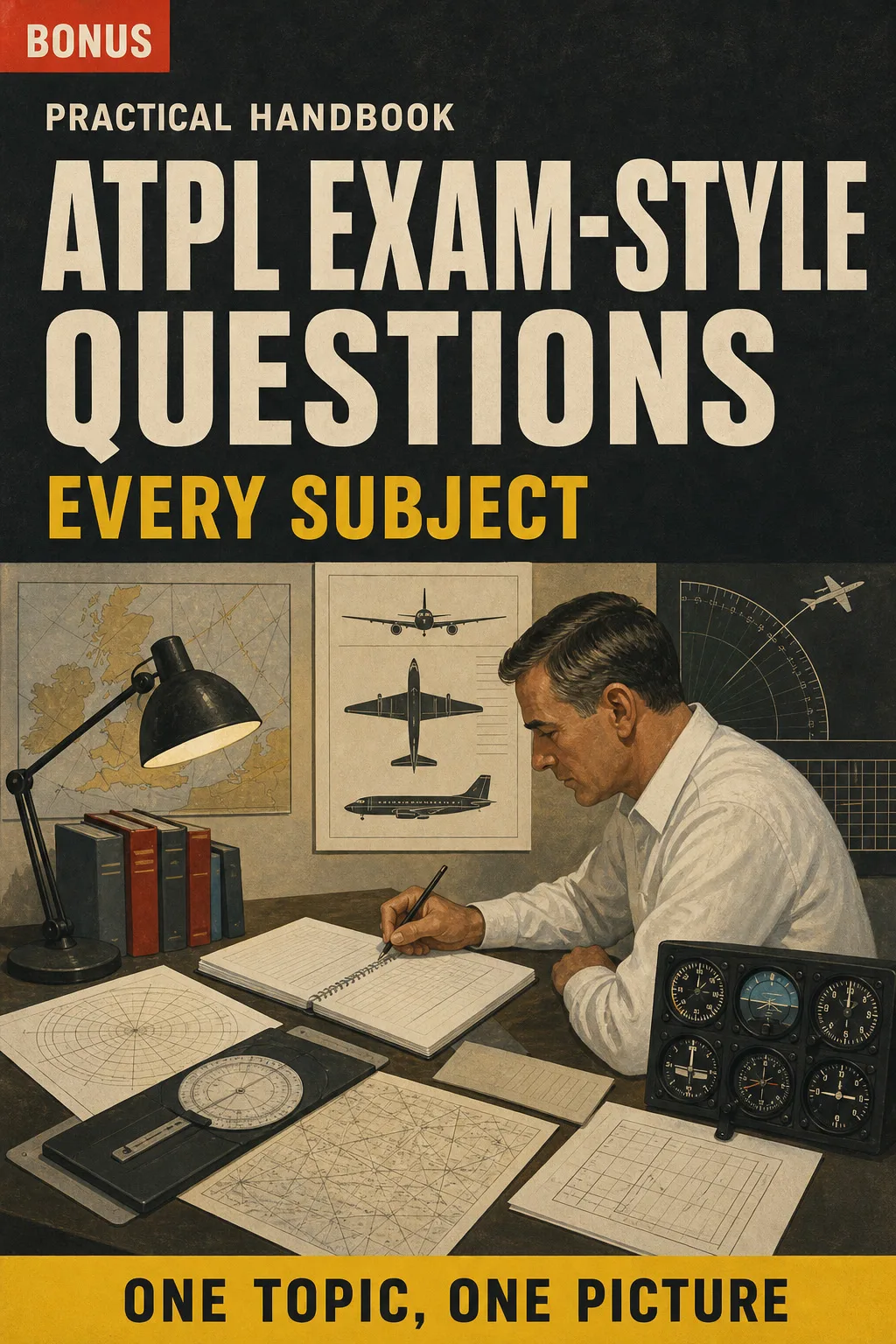
ATPL Exam-Style Questions: Every Subject

BONUS 1: «ATPL Exam-Style Questions: Every Subject»

Value on its own: US$ 17.90

Practise with exam-style questions for each subject, with the answer and a one-line explanation of why, so you learn the idea instead of memorising the letter.

The 15 Most Common ATPL Theory Mistakes

BONUS 2: «The 15 Most Common ATPL Theory Mistakes»

Value on its own: US$ 14.90

See the mistakes students make most often, from great-circle direction to CG shift sums, drawn before and after, so you spot them in the exam.

ATPL(A) Theory Illustrated with 2 Free Books

  • ATPL(A) Theory Illustrated: 66 illustrated pagesUS$ 63
  • BONUS 1: ATPL Exam-Style Questions: Every SubjectUS$ 17.90
  • BONUS 2: The 15 Most Common ATPL Theory MistakesUS$ 14.90
  • High-resolution PDF to printIncluded
Total value US$ 95.80
YOUR PRICE:
US$ 27
You save US$ 68.80
YES, I WANT ATPL(A) THEORY ILLUSTRATED FOR US$ 27

📄 This is a digital PDF book sent to your email: nothing is printed or shipped.

Secure purchaseEncrypted payment30-day guarantee

PDF by email: We email you ATPL(A) Theory Illustrated as a PDF, together with the two free books. It's a single payment: no installments, no extra charges.

Who This Book Is For

You're working through ground school

You're working through ground school

Each module's topics drawn on one page each, so what you study after work still makes sense the next morning.

Your exam sittings are booked

Your exam sittings are booked

A fast revision pass through every subject, in the same order, with the formula page and the numbers to have at hand.

You're heading for the sim and the airline assessment

You're heading for the sim and the airline assessment

The picture behind the key systems and procedures, at a glance, so you can explain them to an instructor instead of reciting a letter.

Everything You Get Today

US$ 95.80US$ 27
YES, I WANT ATPL(A) THEORY ILLUSTRATED FOR US$ 27

📄 This is a digital PDF book sent to your email: nothing is printed or shipped.

30DAYS
GUARANTEE

30-Day Guarantee

Try ATPL(A) Theory Illustrated for 30 days, bonus books included.

We refund everything if the file won't open, if the book isn't what you see here, if you were charged twice or if the email doesn't arrive. Just email us.

You pay once. No subscriptions.

Frequently Asked Questions

Is it for me if I'm studying modular ATPL(A) theory in the evenings after work?

Yes. It's written for UK students following the current UK CAA syllabus, at ATPL level, but in short sentences and drawings you can get through after a working day.

Where does the content come from?

From the learning objectives of the ATPL(A) theoretical knowledge syllabus published by the UK Civil Aviation Authority under UK Part-FCL, checked topic by topic. Where UK rules differ from EASA, as in Air Law and UK airspace classes, the book follows the UK rules.

Is it official material?

No. It's an independent study guide, not affiliated with or endorsed by the UK Civil Aviation Authority or any training organisation.

Does it replace my ground school course?

No. It's a revision companion for your approved course and your instructors, not a substitute for them. Its 66 pages don't cover every learning objective: they draw the core topics of each of the 13 subjects, the ones that make sense with a picture, so the answers in your question bank finally have a drawing behind them.

Are the practice questions the real exam questions?

No. They're exam-style questions written for this book, each with the answer and a one-line explanation of why.

When and how do I receive it?

As a PDF by email, at the address you enter at checkout. The 2 free books come the same way.

Do I have to pay every month?

No. It's a one-off payment, with no subscription.

Can I have it on paper?

Yes. The PDF prints well at home or at a print shop, so you can take it to the airfield.

How does the refund work?

You have 30 days. We refund everything if the file won't open, if the book isn't what you see on this page, if you were charged twice or if the email doesn't arrive: just email us.

Before You Close This Page

No more rereading that doesn't stick.

Fronts, VOR radials and the mass ladder: you see them drawn, and that's it.

Before each exam sitting, one pass through every subject, always in the same order.

Drawings make studying faster.

The book is right below.

One-time payment: US$ 27 · Guarantee: 30 days · PDF by email

YES, I WANT ATPL(A) THEORY ILLUSTRATED FOR US$ 27

📄 This is a digital PDF book sent to your email: nothing is printed or shipped.